Service Detail
Artificial Grass Repair in Mesquite, TX
Artificial Grass of Mesquite provides professional repair services for artificial turf across Mesquite and the east-metroplex corridor. Seam failures, edge lifting, infill depletion, storm damage, and fiber compaction — we assess the specific issue and repair it properly rather than patching over a problem that will resurface.
Service areas for this work
Overview
When Artificial Turf Needs Professional Repair
Artificial turf lasts 15 to 20 years when properly installed and maintained, but problems do develop — especially with older installations that were originally built on sub-standard bases, seamed improperly, or maintained inadequately. Artificial Grass of Mesquite provides repair assessments and services for turf installations across our service territory, working on systems installed by other companies as well as our own. We diagnose the actual cause of the failure before recommending repair, because fixing the symptom without addressing the root cause means the problem returns.
That first conversation helps clarify whether the project is mostly visual, mostly performance-driven, or a mix of both. Once that is clear, it becomes much easier to identify the right turf system and the right installation path.
Service Snapshot
What the work usually needs before it starts.
- Seam failure repair: re-bonding or re-seaming sections that have separated or lifted
- Edge and perimeter repair: re-securing edges that have lifted or detached from the perimeter system
- Infill replenishment: restoring depleted infill that has reduced drainage and cushioning performance
- Fiber restoration: addressing sections of severe matting that haven't responded to grooming
- Turf section replacement: replacing damaged sections where the fiber or backing has failed beyond restoration
- Drainage correction: addressing base or backing drainage failures that have created surface water retention
Long-Form Detail
The service template now carries real body content beyond the hero.
These sections are intentionally substantial so service routes do not collapse into thin pages once the visual redesign is applied.
Where artificial grass repair fits
Artificial Grass Repair projects in Mesquite usually start with a practical question: what does the space need to do once the job is finished? For some properties the answer is visual consistency and lower maintenance. For others it is pet durability, easier cleanup, cleaner curb appeal, or a more controlled recreational surface. That usage question affects the scope, the materials, and how the site should be prepared before work begins.
Because the space has to perform after installation, we evaluate grade, traffic, drainage, access, and edge conditions before locking in the final plan. That is especially important in North Texas, where seasonal heat, sudden rainfall, and day-to-day wear can expose weaknesses in poorly planned turf systems. A service page is only useful if it explains that context, so this route keeps the Mesquite-specific detail and not just a short marketing summary.
Planning factors before the work begins
This service also ties directly into planning priorities like repair cost vs. replacement cost, address the problem, not the symptom, restore drainage before it becomes a bigger problem. Those items are not abstract selling points. They influence product selection, base preparation, finishing details, and how the completed surface should be maintained over time. Whether the project is residential or commercial, those planning factors shape the final recommendation more than a one-size-fits-all material choice ever could.
Customers also need a realistic understanding of sequencing. Some sites need more prep than expected. Some benefit from a simpler scope because the existing conditions are already strong. Walking through those choices ahead of time keeps the estimate process cleaner and makes the finished result easier to match to the original project goals.
What customers can expect from this route
On the execution side, artificial grass repair work is shaped by details such as Seam failure repair — re-bonding, re-cutting, and re-seaming separated or lifted seam joints, Edge and perimeter re-securing for lifted or detached edges along concrete, wood, and masonry boundaries, Infill replenishment — restoring depleted silica sand, rubber, or antimicrobial infill. Those details influence how natural the turf reads, how it handles traffic, and how much maintenance pressure stays on the property owner after the work is complete. The route is built to explain those choices so customers know what the finished system is supposed to deliver.
The end goal is a turf solution that feels appropriate for the property rather than overbuilt or underspecified. That means the recommendation should look right, hold up to the expected use, and come with a straightforward explanation of how the site should be cared for after the handoff.
Benefits
Why Repair First, Replace Later
The benefits below stay pulled from the existing content batch, but the presentation has been expanded into a denser editorial grid to better match the new theme.
Repair Cost vs. Replacement Cost
A seam repair, edge re-securing, or infill replenishment costs a fraction of a full turf replacement. If the existing installation has life remaining — fiber quality is acceptable and the base is intact — repair is the financially responsible first step. We assess whether repair is the right choice or whether the installation has reached end-of-life during the initial evaluation.
Address the Problem, Not the Symptom
A seam that has separated once will separate again if the cause isn't corrected. A lifting edge will lift again if the soil movement creating the lift isn't addressed. Artificial Grass of Mesquite's repair service starts with diagnosis — we identify why the failure occurred before determining how to fix it, so the repair holds.
Restore Drainage Before It Becomes a Bigger Problem
Drainage failures — backing clogged with debris and fine organics, base compaction disrupting flow, surface pooling in low areas — damage the sub-base and backing system if left unaddressed. Catching and correcting a drainage issue during a repair visit is significantly less expensive than allowing it to deteriorate into a full base-replacement requirement.
Extend the Usable Life of a Good Installation
An installation on a well-prepared base, with quality fiber, that has simply developed a seam issue or edge problem can serve another decade with appropriate repair. We don't push replacement when repair is the right answer.
Same-Day Minor Repairs
Many repair situations — minor seam re-bonding, edge re-securing, infill replenishment — can be addressed during a single repair visit. We arrive prepared for common repair scenarios and don't schedule multiple visits for straightforward issues.
Documentation for Warranty Claims
For installations within the manufacturer warranty period, documented repair assessment and service can support warranty claims. We provide written documentation of repair work performed for homeowners managing warranty coverage on their installation.
Process
Artificial Grass Repair Process
Artificial Grass of Mesquite approaches every repair assessment the same way: diagnose first, repair second.
Step 01
Repair Assessment Visit
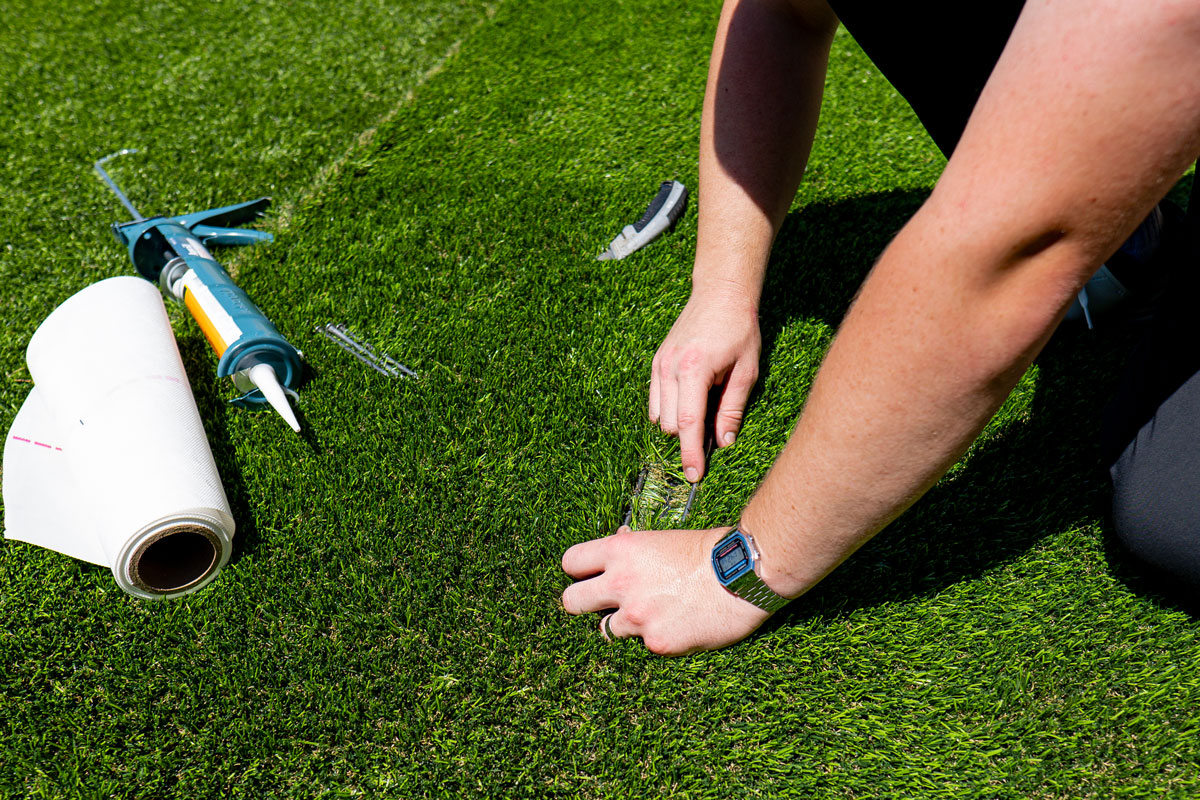
We visit the property and evaluate the specific failure: what failed, where it failed, and why it failed. The assessment includes examining the sub-base condition under the problem area, checking seam adhesive integrity, evaluating backing and fiber condition, and assessing drainage performance.
Step 02
Repair Scope and Cost
We provide a written repair scope with the specific issue, the repair approach, any materials required, and the repair cost before any work begins. We also note whether the assessment found conditions suggesting additional areas at risk.
Step 03
Root Cause Correction (Where Applicable)
Where the failure has an underlying cause — base movement from clay cycles, tree root intrusion at the perimeter, inadequate original drainage slope — we address the cause as part of the repair rather than simply re-bonding the surface over an ongoing problem.
Step 04
Repair Execution
We execute the repair using materials appropriate for the existing turf system. Seam adhesive is matched to the backing type. Section replacements use material that matches the existing turf fiber color and pile height as closely as available product allows.
Step 05
Post-Repair Inspection
Following repair, we inspect the surrounding area for additional concerns identified during the assessment and confirm the repair is complete before closing out the visit.
Step 06
Maintenance Guidance
For repairs resulting from maintenance neglect — infill depletion, organic debris drainage blockage, cleaning inadequacy — we provide maintenance guidance to prevent recurrence and discuss professional maintenance schedules appropriate for the property.
Materials + Scope
Features, product notes, and budget context.
- Seam failure repair — re-bonding, re-cutting, and re-seaming separated or lifted seam joints
- Edge and perimeter re-securing for lifted or detached edges along concrete, wood, and masonry boundaries
- Infill replenishment — restoring depleted silica sand, rubber, or antimicrobial infill
- Localized turf section replacement for areas with failed fiber or backing
- Backing drainage correction — cleaning blocked drainage holes and addressing infill compaction
- Sub-base repair where base movement has created surface irregularity or seam stress
- Fiber restoration grooming for sections of heavy matting that haven't responded to standard brushing
Budget + Expectations
Repair Pricing
Artificial grass repair pricing depends on the type and extent of the failure — a single seam re-bond is priced differently from a multi-area section replacement with sub-base work. We provide written repair quotes after the assessment visit. Assessment visits are priced based on location within our service territory. Contact us to discuss your specific repair situation.
We service turf installed by other companies as well as our own installations. Bring us a description of the issue and we'll assess whether repair or replacement is the appropriate recommendation.
FAQs
Repair Questions from East-Metroplex Homeowners
The frequently asked questions stay on the route, but they now sit inside the same card system as the rest of the redesign.
A seam in our turf has come apart. Can you fix it without replacing the whole installation?
In most cases, yes. Seam failures that result from adhesive failure or original installation error are repairable without full section replacement. We assess the seam condition and the surrounding turf state during the repair visit and give you a specific answer for your installation.
Our turf edge is lifting along the fence line. What causes that?
Edge lifting typically results from one of three things: inadequate original securing, soil movement at the perimeter from clay expansion and contraction, or root pressure from adjacent trees or plants pushing the edge. We identify the specific cause during the assessment and address it as part of the repair so it doesn't recur.
The turf in one section looks much flatter and older than the rest. Can that be fixed?
Section-level fiber degradation — whether from UV exposure on a south-facing area, heavy compaction from concentrated use, or original product variance — can sometimes be improved with professional grooming and infill restoration. If the fiber has genuinely failed, section replacement with the closest-matching available product is the appropriate repair. We'll be honest about which situation you have.
We have a pool of water collecting under our turf after rain. What's wrong?
Surface water retention under artificial turf indicates either a backing drainage failure — blocked drainage holes — or a base drainage failure where the aggregate base has lost its drainage slope or has become compacted to the point where water can't percolate through. We diagnose the specific cause during the assessment and can address both types.
Do you repair turf that another company installed?
Yes. We assess and repair artificial turf regardless of who installed it, subject to the installation being in a repairable condition. Contact us with a description of the issue and we'll discuss whether a repair assessment visit makes sense for your situation.
How do I know if repair is worth it or if I should just replace the turf?
That question depends on the condition of the fiber and the integrity of the base — two things we can assess during the repair visit. If the base is intact and the fiber has life remaining, targeted repair is almost always the better financial decision. If the base has been compromised or the fiber is at end-of-life, replacement may be the honest recommendation. We'll give you a straight answer.
Related Services
Explore adjacent turf routes.
These links give the service template a stronger internal-linking finish and make the redesigned system extend across the full service family.
Artificial Grass Installation
Professional Artificial Grass Installation in Mesquite, TX.
View service
Artificial Turf Maintenance
Professional Artificial Turf Maintenance in Mesquite, TX.
View service
Synthetic Grass Cleaning
Professional Synthetic Grass Cleaning in Mesquite, TX.
View service
Pet Friendly Artificial Grass
Professional Pet Friendly Artificial Grass in Mesquite, TX.
View serviceService Areas
Get Your Turf Assessed and Repaired
Call Artificial Grass of Mesquite at or submit a contact request online to schedule a repair assessment. We'll diagnose the specific issue, provide a written repair quote, and fix it properly — so you're not dealing with the same problem again six months from now.